Pastor Brad Hoefs

Pastor | Author | Speaker | Hope Coach | Mental Health Advocate

5 Ways to Develop a Healthy Church Culture In Regards to Mental Illness By: Katie Dale

5 Ways to Develop a Healthy Church Culture In Regards to Mental Illness By: Katie Dale
  1. Talk About It

Start with the preaching from the pulpit (that’s you, pastors!) Include stories about those who have personally experienced mental illness as testimonies, to how they have experienced hope and healing in practical mental health treatment and results. Normalize its reality from the pastor’s perspective. Have a guest subject matter expert or success story from a church member who’s managed their illness to come in and speak to the congregation on a Sunday morning or Wednesday night. Hold a panel discussion inviting multiple field experts and host a talk on what the church can do to help those with mental illness. Make these events open to the church and the community.


2. Learn About It

If you are church leadership, look into material on mental illness and ways the church can help. Read books like Mental Health and the Church, Grace for the Afflicted, Troubled Minds, and Fresh Hope. Make these resources available and recommended for your ministry leaders to read and learn from. Invite a guest speaker to teach on it for a church leadership program or open it up to the congregation and invite the outside community for a conference.


3. Hold a Support Group

There are support groups like Fresh Hope for Mental Health, and Grace Alliance that can help your congregation and church members who struggle. The groups are usually member-initiated, pastor-approved, and peer-led. That means the ones facilitating must have a diagnosis and be maintaining a healthy functioning lifestyle. The support group curriculums are provided in the programs. If you are going to start your own group without a pre-existing organization’s curriculum program, research those that have done this before like Dr. Stanford’s, Dr. Grcevich’s, and Tony Roberts’ ministries found in this post on BipolarBrave.com


4. Advertise and Share about the Success of the Group

Make sure your congregation and community find out about the group and you have the resources to advertise and spread the word. You might advertise by investing in Facebook ads, a vinyl banner in front of the church, a blurb in the Sunday bulletin, an ad in the local newspaper, and through your denomination’s communications/newsletter. Get the word out.


5. Love and Support Each Other Practically

Be the hands and feet of Jesus and personally get to know other people who have mental illness. Form friendships, cultivate relationships, forgive when necessary, come alongside for practical needs when there are barriers to care. Practical ways you can help may range from providing transportation to medical appointments or hospitals, to a meal train for the family while a loved one with a diagnosis is away, to sending the member a card in the hospital, to sitting with and praying for them, and listening. These may seem like minor ways, but to the ones struggling, they make a huge difference.


Katie Dale is the mind behind BipolarBrave.com and GAMEPLAN: Mental Health Resource Guide. She anticipates the release of her first book, a memoir of her psych hospitalizations entitled But Deliver Me from Crazy, due March 2020. She enjoys her long runs and long naps to keep her bipolar in remission and resides in central Missouri with her husband and cat. You can follow her activity on Facebook, Instagram and Twitter.


The Internet and Social Media: Friend or Foe? By: Jamie Meyer

The Internet and Social Media: Friend or Foe? By: Jamie Meyer

By: Jamie Meyer

I did it again.  Checked my email and Facebook notifications before my morning coffee has even finished brewing.  Before I know it I’m on my Facebook feed to see who has posted since I last checked. Next thing I know, two hours have passed and I haven’t moved from my comfy chair.  As a person who lives with mental health challenges I have to ask myself: Is this a good thing or bad? The answer I’ve arrived at after much contemplation is this: It all depends on what I use social media and the Internet for, how often, and if I’m able to control my use of it.  

No doubt, there are good things to be found on the Internet such as reputable websites to learn about specific diagnoses and options for treatment.  Websites I’ve found helpful include Mental Health America, the National Institute of Mental Health and Psych Central. Diagnosis-specific websites are also available such as DBSA for depression and bipolar, and the ADAA for anxiety and depression.

You can also find topic-specific forums or message boards online where people can have conversations via posted messages.  These are useful for mutual support, especially if you’re isolated at home or it’s 3am. Many people benefit from online support groups.  An online search of “mental health online support groups” will give you several options to check out. Fresh Hope offers both online support groups and mental health forums.

Social media such as Facebook, Instagram, Twitter and Snapchat can be both helpful and hurtful.  While I enjoy keeping up with the lives of family and friends and seeing their pictures, it eats up a big chunk of my day. For many people, being on social media can cause feelings of inadequacy, shame and envy.  It helps to keep in mind that we tend to compare our insides to other people’s outsides. What some people project on social media is really a mask to make others think their life is full of fun and adventure, when in reality their life lacks meaning or enjoyment.

To make social media and the Internet safe, healthy and helpful for those of us with mental health issues, I’ve come up with a few suggestions:

  1. Set a daily allowance for the amount of time you spend online. Use an alarm if necessary.
  2. When doing an Internet search, stick to well-known medical or mental health organizations (such as WebMD or NAMI).  A safe website will have an https:// before the address. Avoid websites hosted by individuals who are simply looking for an audience for their opinions.
  3. It’s ok to not “Like” or comment on everyone’s Facebook post or send birthday wishes to every “friend.”  Sending a text, email or card is more personal and meaningful to the receiver.
  4. When you post, don’t obsess over the number of “Likes” you receive.  It sets you up for feeling inadequate.
  5. Avoid going online when you’re experiencing a severe episode.  You’re less likely to think clearly and may end up more depressed or risk the chance of sharing something you’ll regret later.
  6. Check in with yourself.  Am I online to numb out or escape real life?  Am I using it to avoid responsibilities or get adequate sleep?


If you’re unsure if the Internet and social media has become an obsession, why not try going cold turkey for 24 hours?  It’s not easy, I know, but it helped me see how much time my computer use cut into each day. And the bonus? It feels pretty darn good to be free.


Fresh Hope is a faith-based non-profit that empowers people to live well in spite of their mental health challenge.

YOUR gift will provide a person with God’s Fresh HOPE for daily living. Click here to donate, today.

unnamed

Forgiveness: The Power to Heal by Jamie Meyer

Forgiveness: The Power to Heal by Jamie Meyer

By: Jamie Meyer

Holding a grudge and refusing to forgive hurts you more than it hurts the other person. I liken it to being held captive by a ball and chain. Unable to move forward in life we remain stuck in the past, continually ruminating on what someone did to us. Unforgiveness makes it more difficult to “live well” in spite of having a mental health diagnosis.

It’s human nature to want justice. We want the other person to pay for what they did. At the very least we want an apology. Deep down we even question whether the way we were treated contributed to triggering our mental illness or worsened it.

How were you hurt at the hands of another? Were you bullied, made fun of, or stigmatized because you were different from your peers? Maybe you were hurt, or continue to be, in a relationship. They didn’t understand so they said hurtful things, ignored you, or walked away, leaving you feeling abandoned and alone. I’ll let you fill in the blank.

As is true of all things in God’s kingdom, hope for healing is found in Christ alone. Are you thinking that there’s no way you can possibly forgive your enemy? Jesus tells us “With people it is impossible, but not with God; for all things are possible with God.” (Mark 10:27). I think that pretty much covers everything, no matter how grievous the violation. If we invite God into the process, then forgiveness is possible.

Refusal to forgive is often the result of not understanding what it means to forgive a person. Forgiveness doesn’t mean you have to forget what the person did or tell yourself the hurtful experience didn’t matter. As much as you might want to, you can never erase those painful experiences from your memory.

Forgiveness does not mean you let the other person off the hook either. They are still responsible for what they did. The person who hurt you may never come to you and say they’re sorry. In fact, they may have already passed away. Regardless, it’s comforting to know they’re accountable to someone greater than you: “Never take your own revenge….’Vengeance is mine, I will repay,’ says the Lord.” (Romans 12:19).

Probably the greatest misunderstanding about forgiveness is that it involves reconciliation with the offender. That’s wonderful if it’s something you want but in most cases there’s no desire to restore the relationship. Why risk the chance of being hurt again? Part of caring for ourselves and maintaining stability requires choosing healthy relationships.

Forgiveness is a process, one that takes time. You don’t wake up one morning and decide you’re going to forgive someone. Telling yourself “I forgive ___” won’t take away the hurt and resentment you feel.

A better place to start is by asking yourself some questions: Do I honestly believe the person who hurt me will someday tell me they’re sorry for their actions? What if they did apologize and beg for my forgiveness? Would that make up for the damage it caused in my life, the happiness and peace of mind I could have had, or how my life may have turned out differently? If that day came, it honestly wouldn’t be enough.

The process of forgiveness begins with accepting the reality that in all likelihood there will be no admittance of guilt, no apology, nor will they have become a better person over time. Letting go of those expectations and the need to get even will enable you to break free of the ball and chain.

The past and its memories will always be a part of you but you’ll no longer be weighed down by them emotionally. Although the length of time it takes to heal varies from person to person, forgiveness is something you do for you. In return you receive freedom, joy, inner peace, and the ability to move forward with hope.


Fresh Hope is a faith-based non-profit that empowers people to live well in spite of their mental health challenge.

YOUR gift will provide a person with God’s Fresh HOPE for daily living. Click here to donate, today.

unnamed

Finding Emotional Satisfaction

Finding Emotional Satisfaction

Having a mental health issue can be and usually is life altering.  So often after coming to terms with the diagnosis and the side effects of medicine can leave you asking, “Is this as good as it gets?  Really??”  This can lead us to believe that life is “over” as we knew it.  In fact, it can lead us to actually feeling lifeless.

In the edition of Fresh Hope for Mental Health, Pastor Brad and Jason Petersen discuss how Jason found his emotional satisfaction, his “sweet spot” for living after being diagnosed.  Jason talks opening about his journey to finding his passion for life once again.

Jason is a husband, dad, business owner and video blogger.  Be sure to check out his website at: www.JasonPetersen.com

After listening to this podcast we encourage you to email us at Podcast@FreshHope4MentalHealth.com with a comment or question that we will share on our next podcast.  Or you can leave a voice message for us on the site: www.FreshHope4MentalHealth.com

To listen to the podcast click on the icon below:

FH PodCastArt (160dpi) 02_Splash 480x854


Fresh Hope is a faith-based non-profit that empowers people to live well in spite of their mental health challenge.

YOUR gift will provide a person with God’s Fresh HOPE for daily living. Click here to donate, today.

unnamed

Perfection Versus Imperfect Progress

Perfection Versus Imperfect Progress

While waiting to weigh in at a Weight Watchers meeting many years ago, the woman in front of me stepped on the scale and began to cry. The leader, who was the person weighing her in, asked her why she was crying. Between her sobbing and trying to catch her breath, she said that she didn’t have a good week. The leader, of course, asked her why. And she replied that she had eaten some peanut M&Ms. The leader then asked her a very important question: “Did you eat as many of them as you would have consumed before coming to our group?” And the woman between her tears and sobbing chuckled and said,”Ohhhh NO! I only ate a small bag of them. Before group, I would have a huge family size bag!” The leader simply looked at her and said, “Good! See, that’s progress!”

The memory of that lady weighing in has been forever etched in my mind. It was at that moment I learned a life lesson about recovery; recovery is not about perfection, rather it is about imperfect progress.

If you’re like me when you step back into old patterns or are triggered by a situation and react in old ways you can easily believe that you have failed at recovery. And when this happensbrad-and-donna and old feelings come back like someone unleashed Hoover Dam: guilt, shame, anger, sadness, confusion, hurt and much more. And the overriding feeling is one of total failure. But, the truth is that it is not a total failure. It is imperfect progress if you recognize it and learn from it. See, it’s only failure if you don’t learn from it if you don’t recognize it. It’s only failure if you decide not to get back and remain “there.”

Again, this “journey of wellness” is not one of perfection. It is a journey of imperfect progress. To make this journey you and I must be willing to accept the fact that we are never going to be perfect. No one is perfect. Recovery, which I define as taking back one’s life in a new way, is built upon failures in which we learn from them, get back up and continue to move forward. Shaming ourselves and believing that a failure constitutes us as complete failures simply is a lie straight from the pits of hell! Everybody fails. Everyone falls short of the mark. What makes the difference between those who decide to give up and believe the lie that they are total failures versus those who succeed? It’s simple; understanding that moving forward is one of imperfect progress versus perfection.

Note: it is never too late to get back up and dust yourself off after failing, even after years of failures. No matter how long you might have been stuck believing the lie that you will never be able to change or move forward, it’s not too late to get back up, dust yourself off, learn from what has happened and begin to move forward. It is NEVER too late. When getting back up, it is important to take full responsibility for your issues. Make amends if necessary and decide to learn from it.

When failures involve others that we are in a relationship with it can be difficult to get out of the “stuck spot” of believing the lie of never being able to move forward when the other person doesn’t let it go. This type of situation is very challenging. When someone is “stuck” and not letting go of the past it can trigger you. It is at that point that you have to know that you’ve done what you can about the past (reconciling, taking responsibility, apologizing, asking for forgiveness, etc.), and you need to recognize that it is no longer your issue, it is theirs. I’m learning that when this happens within my relationships with others that I absolutely must have a loving response to their reminders of the past instead of getting triggered and repeating the same things over and over.

I want to encourage you. You are not a failure. Yes, sometimes you fail. So, does everyone else. But, failing does not make you a failure. Failing is a sign of moving forward and learning from it. Wellness does not require perfection at all. It is made up of imperfect progress that is simply handling one’s failures in a healthy and appropriate way.

How about you? Do you want to give up because you “slipped up”? Do you want to give up because this journey of wellness is hard work? Are you learning from your imperfect progress?

Check out Brad’s weekly podcast: Fresh Hope for Mental Health (www.FreshHope4MentalHealth.com)

Fresh Hope is a faith-based non-profit that empowers people to live well in spite of their mental health challenge.

YOUR gift will provide a person with God’s Fresh HOPE for daily living. Click here to donate, today.

How I Dealt With People With People Who Didn’t Understand My Mental Health Issues

How I Dealt With People With People Who Didn’t Understand My Mental Health Issues

By: Stan Popovich

Throughout my 20 years of personal experience in dealing with fear and anxiety, I had a challenging time in getting my friends to understand my issues with fear, stress, and anxiety.

Most of my friends and relatives were understanding and very supportive of the fact that I struggled with fear and anxiety, however, there were times some of my friends were not very supportive. The problem was that some of these people got on my case and did not understand my situation. In order to deal with these people, I did the following.

The first thing I did was to listen to the mental health professionals and not my friends. My friends meant well but I realized that the professionals knew my situation since they were trained in the mental health fields. These professionals knew what I was going through and were properly trained. So I made the choice to listen to them and follow their advice and not my friends.

I also realized that my goal was to overcome my fearful situations and not to please my friends. I realized that I wasn’t going to waste my time arguing with my friends who were giving me a difficult time. I realized that this was not a public relations event where I needed to get everyone’s approval. This was my life and my focus was to find the ways to manage my fears.

I told my friends that the best way for them to help me was to learn more about my situation and to be more understanding. I suggested they could talk to a mental health professional, read some good books, or attend a support group where they could learn about my situation. This would give them some idea of what I was going through and hopefully would become more supportive. I also asked some of these mental health professionals on ideas on how to deal with people who were giving me a difficult time.

Some of my friends took my advice and others didn’t do anything. I eventually made the decision to distance myself from people who gave me a difficult time. This seemed cruel however I realized that if I had friends who were hindering my progress in getting better that it was better if they stayed away from me and go bother someone else. As a result, I distanced myself from those people who wouldn’t make an effort to help understand what I was going through. I surrounded myself with positive and supportive people.

It can be difficult dealing with people who get on your case and who do not support you. Many of these people think they know what is best for you, but the fact of the matter is that their advice could make things even worse. I had one friend who thought he knew everything, but the fact of the matter was that he didn’t have a clue and he gave me bad advice. Always listen and follow the advice of a mental health professional and not your friends.

I made the decision that I wanted to overcome my fearful issues and that it was not my job to get everyone’s approval. No matter what you do in life, there will always be people who will not agree with you. I realized that my mental health was more important than pleasing people who were close minded and stubborn. My advice is not to waste your time and energy on these people.

Stans-bio-slide

Fresh Hope is a faith-based non-profit that empowers people to live well in spite of their mental health challenge.

YOUR gift will provide a person with God’s Fresh HOPE for daily living. Click here to donate, today.

unnamed

Fresh Hope Offerings and Resources during COVID-19.

Fresh Hope Offerings and Resources during COVID-19.

Here is what Fresh Hope is offering during this unprecedented time of stress, uncertainties, and anxiety:

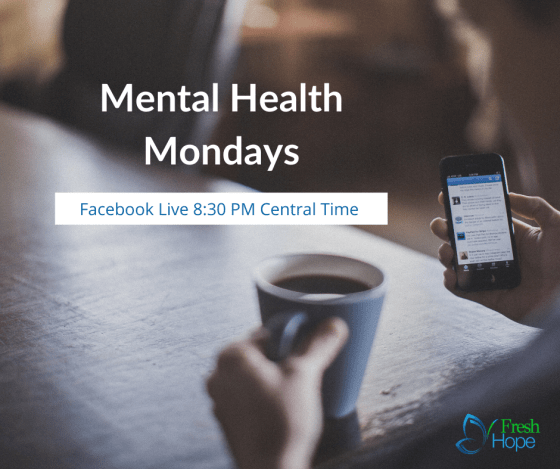
  1. Every Monday at 8.30 p.m. Central Time Pastor Brad is hosting a Facebook Live Event entitled, “Mental Health Mondays.”  He’s covering topics such as anxiety, grief, and trauma, etc. To participate, go to the Fresh Hope for Mental Health Facebook page and scroll down, and you’ll see it there.  (Each week, the replay on demand for it is also on the Fresh Hope for Mental Health Facebook page under the video section.

Mental Health Mondays NEW

2. Three times a week, we are offering a two-hour session entitled: “Healing the Distress Caused by the COVID-19 Crisis.” The material was created by the Trauma Healing Institute, which is part of the American Bible Society. It’s a two-hour free session in which the participants have the opportunity to work through any anxiety, fears, concerns, trauma, grief that they may be experiencing due to the ongoing COVID-19 crisis.  To register for this session, click here.

healingcovidfacebook

3. We will also be providing the same “Healing the Distress Cause by the COVID-19 Crisis” for Children very soon.  To receive notice of when we begin to offer the children’s sessions, please text the word children to (415) 528-7403, and we’ll get you the information as soon as it is available.

4. We also have created a special free downloadable for the ongoing crisis entitled “Managing Coronavirus Anxiety,” which can be downloaded by clicking here.

managingcoronavirus

5. Fresh Hope is also offering a series of six mental health from a Christian perspective type of snippet that pastors and ministry leaders can provide their members and community.  Pastors may request to receive these snippets weekly by texting the word interview to 415-528-7403. These snippets are free and may be used; however, the pastor and ministry leaders see fit to use them.  It’s our desire to help the pastors and ministry leaders to help their members and their community to stay emotionally healthy during this time of isolation.

6. Here are a few of our Fresh Hope for Mental Health podcasts (www.FreshHope4MentalHealth.com) that we believe that are helpful during this time:

40978463_2146431218761517_621991919651651584_n

We of course continue will continue to offer our online Fresh Hope support groups and most of our local groups that used to meet in person are now meeting online also.  People can register for our regular weekly online group meeting by going to www.FreshHopeMeeting.com


Relaxation Tips to Calm Anxiety

Relaxation Tips to Calm Anxiety

Are you feeling anxious lately?   Times are so uncertain now and trying to stay current on the latest COVID-19 news, working from home or keeping up with your child’s homeschooling is enough to make any person anxious.  Maybe your anxious about your safety or what the future holds. Whatever the reason, it is important to find a way to calm that anxiety. Below are some helpful techniques to relax:


  1. Controlled Breathing*: 


Breathe in through your nose, out through your mouth.  Breathe from your diaphragm, not your chest. It helps to stay focused if you think a word upon inhaling/exhaling, such as peace/calm.  Also try counting 1-2-3-4 as you inhale, 1-2-3-4 as you hold your breath, and 1-2-3-4 as you exhale. 


2.  Sounds/Music*: 


Play relaxing music or calming sounds such as nature, ocean, or rain.  Close your eyes and repeat a meaningful word or scripture.  There are lots of videos on Youtube, channels on Pandora or Spotify full of inspirational and relaxing music.


3. Do Something You Enjoy:


Take time to do something you enjoy, whether baking, painting, gardening, knitting, reading or whatever.  Focusing your attention on doing something you enjoy or have enjoyed doing in the past, will help you clear your mind and ease anxiety.


4. God’s Word*:


Find peace in the following scripture verses: John 14:27, Phil. 4:7, Gal. 5:22, Matt. 11:28, Psalm 103:1, Zeph 3:17.

Cast all your anxiety on Him because He cares for you. 1 Peter 5:7

Take some time today to do something calming to ease your anxiety.  You’ll feel better and will better equipped to face the day.

We pray these tips help you.  Remember, we are all in this together and God is with us!  

© Fresh Hope for Mental Health

*(1) Borchard, Therese J. 12 Best Anxiety Busters, belifnet.com, last accessed 8-22-2010, (2) Lucado, Max, Max Lucado on How to Overcome Fear, beliefnet.com, last accessed 8-22-2010.