Real Hope Has Gotten Me Through My Hopelessness

Real Hope Has Gotten Me Through My Hopelessness

Life can be difficult.  No one makes it through life without painful trials and tribulations. And there is no doubt that having bipolar disorder on top of all of the typical trials and tribulations can make life even more challenging.  There’s just no sugar-coating it. Hopelessness happens all too easily.  But life can also be beautiful. The truth is, no one makes it through life without experiencing joy-filled events and blessings.  But having hope and being hope-filled takes effort, unlike hopelessness.

Probably one of the most peculiar things about hope and hopelessness is that they can co-exist in life. When I reflect on the greatest difficulties and deepest depression that caused extreme despair in my life, it was hope that got me through the hopelessness. But it was not the “wishful-thinking” kind of hope that life would get better that got me through the hopelessness.  That kind of “hope” is nothing more than wishful thinking that things may or may not get better.  And that kind of hope was not enough for me.  Hoping that things might get better could not even bring about the smallest of cracks within my despair.

img_6604So what is this “real” hope that got me through and continues to get me through living life with bipolar disorder?  It’s the Real Hope that was born and died on the cross and His promise.  In particular, it is the promise of Romans 8:28 that has gotten me through the many incredibly painful events that could have easily led to the bottomless pit of hopelessness. In Romans 8:28 the apostle Paul tells us that the Lord will work all things together for our good.  As a person of faith, I believe this.  Knowing and believing this real hope does not mean that I stuff my feelings.  Rather, it means that as I feel my feelings I’m able to work through them and deal with them because I know that He will take even the worst of life’s trials and tribulations and make them work together for me for my good.  That’s hope. That’s real.

See, I’ve come to understand how my faith has been instrumental in my living well.  I don’t do wishful thinking kind of hope.  Instead, I do Romans 8:28 hope.  In other words, as I go through difficulties (and there are plenty of them) I recognize them, feel the feelings because I know that the Lord will take all of the pain and make it work for my good. It doesn’t mean that all of a sudden things become easy.  But I’m able to move through the pain, knowing how it will end.

The Lord is the real hope.  The Father sent His Son into our messy world to redeem us.  Born right in the midst of the stench of that stable,He came.  And on that cross, He died for you and me. Out of what appeared to be a hopeless beginning and an even more hopeless death on the cross, He rose as proof that He is indeed our sure and certain hope.

There is no way that I would be living well, much less living, without Him as my hope.  Romans 8:28 has gotten me through the hopelessness. Grab ahold of that hope my friend.  Whatever difficulties you are going through this day, He can and will make though things work together for your good.  No, he doesn’t promise a painless life. In fact, He says that in this life you and I will have difficulties.  Instead, He promises to never leave you, and to take those problems and work them together for your good.  And in knowing this, you and I can move forward in spite of our present circumstances.

On this day, my prayer is that you will grab ahold of the real and certain hope we have that He will take all of your difficulties, pain, and problems, and work them together for your good.  Keeping moving forward: moving one step at a time.  He loves you.  He is with you. He is for you. And Heis at work; making all things work out together for your good!

Blessings my friend,

Brad

Fresh Hope is a faith-based non-profit that empowers people to live well in spite of their mental health challenge.

YOUR gift will provide a person with God’s Fresh HOPE for daily living. Click here to donate, today.

unnamed

“How Joyful People Think: 8 Ways of Thinking That Lead to a Better Life”: Pastor Jamie Rasmussen

On this episode of Fresh Hope for Mental Health, Pastor Brad Hoefs talks with Author and Senior Pastor of Scottsdale Bible Church, Jamie Rasmussen about his book; “How Joyful People Think: 8 Ways of Thinking That Lead to a Better Life.” Why is it important that we change our thinking? How does the Bible tell us to think? Is it possible to have joy when your depressed?

To listen to the podcast click here!

40978463_2146431218761517_621991919651651584_n.png

We encourage you to share this podcast with your friends via your social media connections.

After listening to this podcast, we encourage you to email us at info@FreshHope.us with a comment or question that we will share on our next podcast.

If you are listening to this podcast on iTunes, we encourage you to leave a comment regarding the podcast. Or you can leave a voice message for us on the site:  www.FreshHope4MentalHealth.com


Fresh Hope is a faith-based non-profit that empowers people to live well in spite of their mental health challenge.

YOUR gift will provide a person with God’s Fresh HOPE for daily living. Click here to donate, today.

unnamed

Lessons I Have Learned From My 20 Year Struggle With Fear And Anxiety

Lessons I Have Learned From My 20 Year Struggle With Fear And Anxiety

By: Stan Popovich

Do you currently struggle with fear and anxiety and wish you could talk to someone who can relate to your situation?

If so, I dealt with fear and anxiety for over 20 years and here are some lessons I learned during my mental health struggles.

  1. Listen To The Professionals And Not Your Friends: Your friends may mean well, but when it comes down to it, the professionals know your situation more than anyone. They know what you are going through and are trained to deal with your situation. Consult with a counselor when you have questions about your mental health issues.
  2. Distance Yourself From People Who Give You A Hard Time: Distance yourself from those people who won’t make an effort to help understand what you are going through. You need to surround yourself with positive and supportive people. I felt better when I avoided those people who would constantly argue with me regarding my anxieties and stresses.
  3. Focus On The Facts of Your Situation And Not Your Thoughts: When people are depressed they rely on their fearful and negative thoughts.  Your fearful thoughts are exaggerated and are not based on reality. When you are depressed, focus on the facts of your current situation and not on what you think.
  4. Learn From Your Experiences: In every anxiety-related situation I experienced, I learned what worked, what did not work, and what I needed to improve on as I managed my fears and anxieties. For example, you have a lot of anxiety and you decide to take a walk to help you feel better. The next time you feel anxious you can remind yourself that you got through it the last time by taking a walk.
  5. You Can’t Predict The Future Regardless What Your Thoughts May Tell You: No one can predict the future with one hundred percent certainty. Even if the thing that you are afraid of does happen, there are circumstances and factors that you can’t predict which can be used to your advantage. For instance, you miss the deadline for a project at work. Suddenly, your boss comes to your office and tells you that the deadline is extended and that he forgot to tell you the day before. This unknown factor changes everything.
  6.  Things Change Over Time: Regardless of your current situation, things do not stay the same. You may feel very bad today, but it won’t last forever. Everything changes over time and this includes your current mental health issues.

Fresh Hope is a faith-based non-profit that empowers people to live well in spite of their mental health challenge.

YOUR gift will provide a person with God’s Fresh HOPE for daily living. Click here to donate, today.

unnamed

Fresh Hope Offerings and Resources during COVID-19.

Fresh Hope Offerings and Resources during COVID-19.

Here is what Fresh Hope is offering during this unprecedented time of stress, uncertainties, and anxiety:

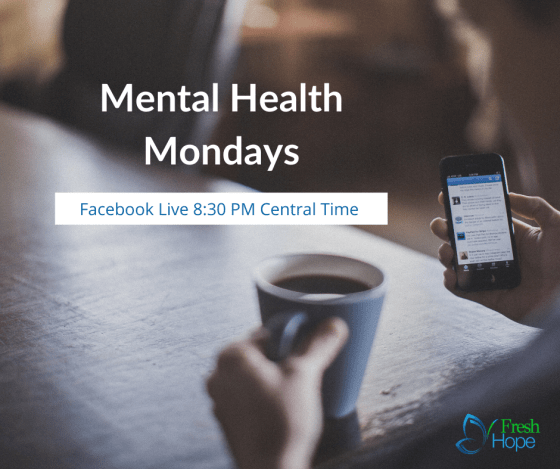
  1. Every Monday at 8.30 p.m. Central Time Pastor Brad is hosting a Facebook Live Event entitled, “Mental Health Mondays.”  He’s covering topics such as anxiety, grief, and trauma, etc. To participate, go to the Fresh Hope for Mental Health Facebook page and scroll down, and you’ll see it there.  (Each week, the replay on demand for it is also on the Fresh Hope for Mental Health Facebook page under the video section.

Mental Health Mondays NEW

2. Three times a week, we are offering a two-hour session entitled: “Healing the Distress Caused by the COVID-19 Crisis.” The material was created by the Trauma Healing Institute, which is part of the American Bible Society. It’s a two-hour free session in which the participants have the opportunity to work through any anxiety, fears, concerns, trauma, grief that they may be experiencing due to the ongoing COVID-19 crisis.  To register for this session, click here.

healingcovidfacebook

3. We will also be providing the same “Healing the Distress Cause by the COVID-19 Crisis” for Children very soon.  To receive notice of when we begin to offer the children’s sessions, please text the word children to (415) 528-7403, and we’ll get you the information as soon as it is available.

4. We also have created a special free downloadable for the ongoing crisis entitled “Managing Coronavirus Anxiety,” which can be downloaded by clicking here.

managingcoronavirus

5. Fresh Hope is also offering a series of six mental health from a Christian perspective type of snippet that pastors and ministry leaders can provide their members and community.  Pastors may request to receive these snippets weekly by texting the word interview to 415-528-7403. These snippets are free and may be used; however, the pastor and ministry leaders see fit to use them.  It’s our desire to help the pastors and ministry leaders to help their members and their community to stay emotionally healthy during this time of isolation.

6. Here are a few of our Fresh Hope for Mental Health podcasts (www.FreshHope4MentalHealth.com) that we believe that are helpful during this time:

40978463_2146431218761517_621991919651651584_n

We of course continue will continue to offer our online Fresh Hope support groups and most of our local groups that used to meet in person are now meeting online also.  People can register for our regular weekly online group meeting by going to www.FreshHopeMeeting.com


6 things I found in the Fresh Hope Support Group By: Samanta Karraa

6 things I found in the Fresh Hope Support Group By: Samanta Karraa

By: Samanta Karraa

When I started attending a Fresh Hope group I found-

  1. People who had a mental health diagnosis, who were living a full and rich life in spite of their diagnosis. They were working, taking care of their families, getting married, getting a master’s degree, serving at their churches and starting new projects in spite of having a mental health challenge. I cannot describe to you how loudly this spoke to me.
  2. A leader who had a diagnosis and therefore could understand me. She was well ahead in her recovery process and had been trained to facilitate the meeting. FH groups function peer to peer. Encouragement and hope are shared amongst the members.
  3. Acceptance. People accepted me for who I am and at the point of recovery in which I was.
  4. Confidentiality. What is said in a FH group stays there. We don’t mention who was at the meeting either.
  5. A community of faith who understood. With so much stigma going around and so much misunderstanding amongst Christian circles, finding a faith-based community who understood mental illness was like finding a treasure. Although the topics introduced at the groups don’t have the format of a bible study, but rather a recovery centered approach, our values and recovery principles are Biblically based.
  6. Answers. After having been diagnosed I had lots of questions and uncertainty. However through the Fresh Hope principles of recovery I received answers to my many questions. And this filled me with hope.

If you´re thinking about attending a Fresh Hope group or starting one in your area, think about it no more. Don´t settle for reading about the things that I found. Go and try for yourself. I am sure you will find these blessings and many more.


Fresh Hope is a faith-based non-profit that empowers people to live well in spite of their mental health challenge.

YOUR gift will provide a person with God’s Fresh HOPE for daily living. Click here to donate, today.

unnamed

3 Types of Questions to Ask a Christian Counselor for Navigating Your Mental Illness By Katie Dale

3 Types of Questions to Ask a Christian Counselor for Navigating Your Mental Illness By Katie Dale

By: Katie Dale 

For most mental health conditions and illnesses, it is strongly recommended that one gets help with not only prescribed medications from a psychiatrist, but also therapy. As a Christian with mental illness, I have found talk therapy with a certified Christian counselor has been hugely beneficial in my recovery and maintenance of my mental health.

Therapy can not only help you feel better but will help you think better and more soundly. Having another party that is unbiased and trained in helping their clients process their emotions, thoughts and behaviors is essential to a return to healthier emotions, thoughts and behaviors.

When the therapist is a Christian therapist and employs Christian, Biblically-based principles in their sessions, a Christian client can gain so much understanding behind their thoughts, feelings and behaviors. Godly wisdom develops in the client when they begin to apply Biblical principles in their thoughts, feelings and behaviors.

In addition to the changes a client makes in Christian counseling, they have the added benefit of making life changes that count for eternity. In other words, when Christ-like habits are formed in place of old sinful ones, the Christian client can employ the power of the Holy Spirit, the strength of Christ, and accept God’s mercy and grace to change permanently and powerfully.

Here are some starter questions in three areas we can explore with a Christian therapist to start on our journeys to permanent change and powerful transformation in light of the Truth of Christ, despite living with a mental illness.

Emotions

  1. What do my emotions have to do with my spiritual walk with the Lord? How are they related and how are they different?

  2. Why might I have such deep depression? Is this related to a sinful thought-life, behavior or generational curse? If not, how do I know it’s purely chemical imbalance?

  3. Why do I feel so far from God right now?

  4. What can I do to avoid a roller coaster relationship to God (highs feeling close to Him, lows feeling far from Him)

  5. Is anger a sinful emotion? If not, how do I appropriately and healthily handle it?

  6. What are triggers and how can I know what mine are?

  7. If I have felt this way for so long, how can I know my feelings will change?

  8. How do I feel differently if I’ve tried to change my thoughts and feelings but I’m still struggling with (fill in the blank: anger, sorrow, grief, etc.)?

Thoughts

  1. Are my thoughts supposed to change once I am a Christian?

  2. I know what I should be thinking about (Philippians 4) but I struggle with what I shouldn’t be thinking about (fill in the blank: jealousy, self-image, self-worth, sexual immorality, etc.). How can I change my thoughts?

  3. What are some tools I can employ when I face a temptation to dwell on what I shouldn’t?

  4. How do I continue to dwell on good, pure thoughts continuously? I seem to always get distracted or give up.

  5. How can I pray about my thought life?

  6. Does prayer count as training my brain to think more healthily?

  7. I feel like my thoughts gravitate toward (fill in the blank) and I know I struggle with this and have in the past. How do I stop this?

  8. What can help me if I am having trouble believing God’s promise about (fill in the blank)?

Behaviors

  1. I have bipolar disorder. Sometimes I get impulsive and act irrationally. How can I manage this behavior?

  2. I have severe depression and am tempted to harm myself sometimes. How can I help myself?

  3. I have severe anxiety and get overwhelmed in public settings. How can I find relief?

  4. I have schizophrenia and can’t always tell the difference between God’s voice and the voices in my head, or hallucinations and Godly visions. How can I know the difference?

  5. I have a learning disability and it takes me a while to catch on to what others are communicating to me. How can I handle my rate of response and frustrations when I don’t understand something?

  6. I take things too personally. How can I be more “thick-skinned” and not be so sensitive? Should I be less sensitive?

  7. I have a short fuse. How can I bite my tongue/control my anger/keep from exploding in the moment and what can help me do that?

  8. I am trying not to lose my job due to my mental health condition. What should I do?

Katie Dale is the mind behind BipolarBrave.com and the e-book GAMEPLAN: A Mental Health Resource Guide. She’s currently finishing up her memoir on her episodes of bipolar disorder, due to launch March 2020. She can be found on FacebookInstagram and Twitter

12 Tips for Managing Your Anxiety

12 Tips for Managing Your Anxiety

Things seem bad enough now, but they say that things are going to get even worse. Stress levels are higher than usual. Anxiety is beginning to set in for many. Things are uncertain. And more than anything, the major question is, “When will it all end?”  

We are experiencing what I would call a type of “world-wide complex trauma.” It’s complex because it deals with a virus that could bring about death. Financial security is at risk for many. There’s a lot of grief. The stress of staying home and isolation causes feelings of loneliness and worry, which all lead to feeling anxious. It’s called anxiety caused by a life-altering ongoing situation where no one can tell us exactly when it will end. Thus, it’s complex.  

Taking care of your emotional health right now is a key to not only surviving these weeks to come, but is necessary to maintain your mental health. And managing your anxiety is at the top of the list when it comes to caring for your emotional/mental health.

So how do you go about managing your emotional/mental health during this time?  

Here are just a few simple suggestions for managing your anxiety:

  1. Recognize the anxious feelings you have.  
  2. Express your feelings of anxiety to a safe person.
  3. Do what you can do; and the things you can’t do anything about, let go. 
  4. Daily find out the latest and most important things you need to know.  
  5. Limit your exposure to news about the crisis (TV, social media, online, and print publications). 
  6. Keep a schedule. 
  7. Make a list of things you need to do, and do them.
  8. Connect with your friends and family through things like Facetime or other real-time apps, email, texts, and even an old-fashioned phone call.
  9. Send special greeting cards to loved ones and other important people in your life. (Right now, Hallmark is giving away cards on their website https://www.hallmark.com/.) 
  10. Get creative. Try something new.  
  11. Tackle a large task that you’ve been putting off for a long time.
  12. Remember to laugh. Laugh loud and laugh often!

If your anxiety begins to become overwhelming, then you need to contact your doctor. Sometimes the anxiety can become so intense that it causes problems with your brain chemistry. There’s no shame in getting some medical help for a medical situation, i.e., your brain not functioning properly due to chemical issues that have come about due to stress.  

More than anything, know that the Lord has this! He is in control. You can trust that whatever happens, He’s going to take it and make it work for your good! (Romans 8:28). So, meditate on His word, spend time worshipping Him, and pray to Him. You can cast all of your cares on Him, for He cares for you!

We do have a more in-depth downloadable article entitled “Managing Coronavirus Anxiety.” Check it out by going to www.FreshHope.us/Coronavirus.

How are you managing your stress and anxiety right now? We’d love to hear from you!


Choosing Hope in the Face of Hopelessness

Choosing Hope in the Face of Hopelessness

Hopelessness is serious. Every day people fall into the hopeless hole of hopelessness due to their struggle with a mental health issue. Hopelessness begins to knock at the door of one’s heart when you feel and believe that you have no future. It happens so easily, and it can take root all too fast. Each time we face one of life’s interruptions which change our perceived future hopelessness can settle in and live rent free in our hearts and minds.

Over 20 years ago I faced a life-altering interruption due to having bipolar disorder. At that time I was pastoring one of the fastest growing churches in my denomination. However, following that painful manic episode, which had interrupted my life, I was asked to resign. It was earth-shattering. My position and the church had become my identity. I was devastated to the point of complete hopelessness. I had lost my future. Hopelessness had set in. And the deep dark hole of depression became a shameful guilt place of familiarity for me; months and months of severe depression followed.

For years prior to this interruption I had felt as though I had a monster inside of me that I had to manage.

The more stress I experienced with pastoring a growing church, the more impossible it was to control the monster within me. More times than not, the monster was controlling me. So, when I was diagnosed with bipolar disorder, I found out that the monster had a name. And strangely enough, a small ray of hope began to break through the hopelessness what had swallowed me whole.

Why would there be a small ray of hope following my diagnosis?   After all, usually people see the diagnosis of bipolar disorder as the difficult thing to accept. Well, it was because of the people around me who helped me to see that the diagnosis and treatment of my bipolar disorder were a way back to having a future. It was the idea that the bipolar could be treated and I could have a future poked a small pinhole of hope into the darkness of hopelessness. It was not an easy journey, but it was more than worth it. With that small pinhole of hope, I could see a way forward. I began to grieve what I had lost and began to embrace a new and different future; believing that I could live well in spite of having bipolar disorder.

Dr. Sean Lopez, the author of Making Hope Happen, has done extensive research on hope for over 14 years. His research supports what I experienced. When I thought I had no future, hopelessness set in and took over. And when I could see the way to a future, hope began to start. And the clearer the future became for me, the more hope I felt.

Interestingly enough, hope can be borrowed, shared and it can be caught! Think about it, if you hang around a lot of hopeless friends, you will begin to feel hopeless. And if you hang out with people who are filled with hope you will begin to feel hopeful.

So, I have a question for you: How is your hope tank doing? Do you feel like you can see a way forward? If not, do you potentially need to let go of the future that as you thought it would be, grieve it and let it go? Do you need to embrace the new potential future? There’s no doubt that doing this is a process. It is not like switching a light switch on. But, it is a choice.

Hope is truly a choice. For me as a Christian, hope is not only a choice, but it is sure and certain. Paul reminds us that no matter what our circumstances might be there is a future because the Lord will work all things out together for our good. (Romans 8:28) So, I certainly may not “feel” hopeful, but I choose to believe Romans 8:28 and that means that there is a future. It may not have been the future as I thought it would be, but it is a future.

So, again, my question is: how is your hope tank? Is your hope tank empty? Is being a caregiver sucking the hope right out of you? Do you see a way forward into the future?

Are you strong enough to make the choice of hope? If not, I have some hope you can borrow.See, I know because of the storms I’ve been through in my life that God is at work in all things. He is with you. He has not left you. He won’t leave you. And He is FOR you and your entire family! He has a plan. It may not be the life you and I planned prior to bipolar showing up, but in spite of us having bipolar disorder He has a plan!

Everything may not be “good” right now, but all is well because of Him. He has heard every single one of your tears as a liquid prayer.   Look for that little tiny bit of light coming through the “pin” hole poking through the hopelessness you might be feeling. Choose hope. Choose it minute-by-minute, hour-by-hour, day-by-day and your feelings will begin to catch up. There is a future and joy is included in it.

Check out Brad’s weekly podcast at www.FreshHope4MentalHealth.com

Fresh Hope is a faith-based non-profit that empowers people to live well in spite of their mental health challenge.

YOUR gift will provide a person with God’s Fresh HOPE for daily living. Click here to donate, today.

shutterstock_60270589


A Key to Thriving in Spite of Your Difficult Circumstances

A Key to Thriving in Spite of Your Difficult Circumstances

Over the last 30 years, I’ve spent untold hours doing pastoral counseling with what seems to be a “gazillion” or more individuals, couples and families. I’ve heard just about everything and seen even more than I’ve heard. I’ve seen what seems to be manageable problems tear families apart. Broken relationships, wounded people, discouragement, and despair seem all too familiar. But, interestingly enough there have been times when I have watched families, couples and individuals actually pull together and become stronger because of overwhelming circumstances that I was sure that no one could go through and “survive”. They not only survived, but they thrived!

I’ve asked myself what it is that those who thrive in spite of horrible life altering circumstances have that those who seem done in by even less severe circumstance do not have? I have come to the conclusion that there are some things that the “thrivers” have in common. And there seems to be one major thing that they all have in common for not just surviving but thriving in spite of their circumstances. What is that one thing? They help others in spite of their circumstances. They regularly and consistently give and help other people in spite of their pain.

Helping and giving to others gives temporary relief to one’s overwhelming circumstances. It has the power to cause a shift in one’s perception of their problems. Time and time again I have seen people going through tragic events in their lives step out of their pain to help someone else. By giving to others their focus changes. When you and I help others in spite of what is going on in our lives, it has the power to change everything. When I move the focus off of myself and onto someone else to give to them, if even for a brief moment, my personal pain is brought into focus.

It seems that when you and I lose our perspective due to our circumstances the circumstances feel even worse. When we focus only on ourselves and how horrible our circumstances might be we allow the circumstances to hold even more power and pain in our lives.

Giving and helping others in spite of what we might be going through is the release valve from the pressures of our circumstances. Just like a teapot the pressure builds in our lives when the circumstances are difficult. There has to be a release of the build up of the environmental pressure, or it leads to potential disaster.

A mental health disorder/illness can be very challenging. It can cause difficult circumstances within one’s life. It can cause you and me to become very self-focused. Which at times is necessary. But, if all we do is focus on ourselves, then bipolar disorder has the potential to hold too much power in our lives. You know what I mean?

How about you? Are you only focused on you and your circumstances? If so, have you thought about helping someone else? Or doing something for someone else? Have you found helping others to be good for you?

Fresh Hope is a faith-based non-profit that empowers people to live well in spite of their mental health challenge.

YOUR gift will provide a person with God’s Fresh HOPE for daily living. Click here to donate, today.

unnamed


25 Inspirational and Insightful Sayings

25 Inspirational and Insightful Sayings

As you might know from some of my past posts I am a collector of inspirational sayings. I find short inspirational quotes to be very helpful in learning how to live well in spite of having a mental health issue.

So, today I thought I would share with you some new quotes that I have found to be helpful:

  1. “To get somewhere new, you must first decide that you are tired of being where you are.” Unknown
  1. “You can’t change someone who doesn’t see an issue with his or her actions.” Unknown
  1. “A moment of patience in a moment of anger saves you a hundred moments of regret.” Unknown
  1. Talking about our problems is our greatest addiction. Break the habit. Talk about your joys. Rita Schiano
  1. “Rock bottom became the solid foundation on which I rebuilt my life.” J.K. Rowling
  1. “Busy is a drug that a lot of people are addicted to in their lives.” Unknown
  1. “Humility is not thinking less of yourself but thinking of yourself less.” Unknown
  1. “What defines is not our past. Rather, how well we rise after falling.” Unknown
  1. “I am no longer accepting the things I cannot change: I am changing the things I cannot accept.” Unknown
  1. “Two things prevent us from happiness; living in the past and observing others.” Unknown
  1. “Your past does not determine who you are. Your past prepares you for who you are to become.” Unknown
  1. “I am not what happened to me. I am what I choose to become.” Unknown
  1. “Never trust your tongue when your heart is bitter.” Unknown
  1. “Failure isn’t final unless you quit.” Unknown
  1. “Just because the past didn’t turn out like you wanted it to or expected it to, doesn’t mean your future can’t be better than you ever imagined.” Unknown
  1. “Let’s stop believing that our differences make us superior or inferior to one another.” Unknown
  1. “Sometimes the bad things that happen in our lives put us directly on the path to the best things that will ever happen to us.” Unknown
  1. “I refuse to please others at the expense of my emotional well-being. Even if it means saying no to people who are used to hearing yes.”
  1. “Faith is the art of holding on to things in spite of your changing moods and circumstances.” C.S. Lewis
  1. “You don’t protect your heart by acting like you don’t have one.” Unknown
  1. “You will never reach your destination if you stop and throw stones at every dog that barks.” Winston Churchill
  1. “Success is not final, failure is not fatal; it is the courage to continue that counts.” Winston Churchill
  1. “Success is going from failure to failure without losing enthusiasm.” Winston Churchill
  1. “Be sure to taste your words before you spit them out.” Unknown
  1. “No one can go back and make a brand new start. However, anyone can start from now and make a brand new ending.” Unknown

Do any of these quotes speak to you? If so, why? Do you have any favorite inspirational quotes that have been helpful to you in learning how to live well in spite of having bipolar disorder?

Check out Brad’s weekly podcast: www.FreshHope4MentalHealth.com